
Nambu-Goldstone Model
Consider a scalar field ,
with a Lagrangian density
.
is invariant under the global U(1) transformation: . Here, global refers to the fact that is not a function of the position x. We now consider two cases.
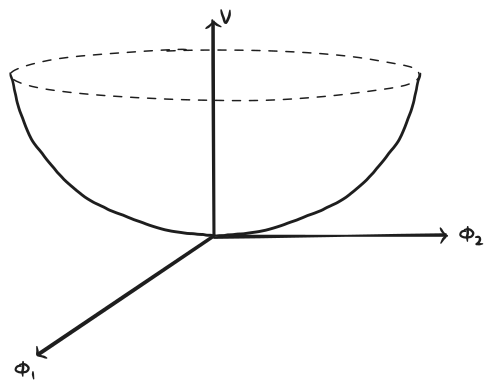
- Case 1: and - The potential has a single minimum at . Hence, the ground state is non-degenerate and therefore shares the symmetry of the potential.
-
Case 2: and - The extrema can be determined as follows:
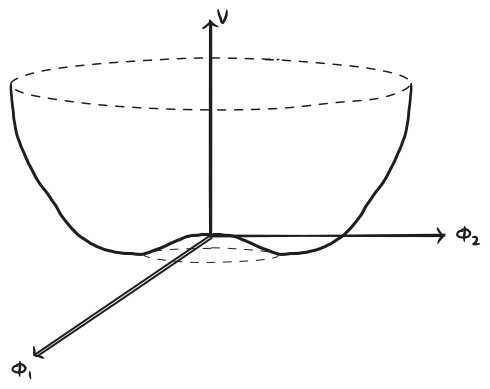
The location of the extrema can be read off V’; they are located at and .
- The former corresponds to a single point with second derivative ; hence it is a maximum.
- The latter corresponds to a set of points with second derivative . They form a valley of minima at the configurations , which is a circle in the -plane.
The ground state is degenerate and hence does not share the symmetry of the potential. The value is called vacuum expectation value (vev) of the field .
A common choice of ground state is and , leading to the matrix element
.
For this (arbitrary) choice, excitations about the ground state are described by
where both and are real fields, representing small deviations from the ground state. Then, the potential becomes
.
Since the terms cubic and quartic in and correspond to the (self-)interactions of the fields, we will choose to ignore them.
Then,
- The field has acquired a mass of . It corresponds to radial oscillations about the ground state. When trying to oscillate radially in the -plane, the field has to overcome the potential barrier at . Such a field that acquires its mass through SSB is referred to as a Higgs boson.
- The field remains massless. It corresponds to angular oscillations about the ground state. When trying to oscillate angularly in the -plane, the field does not have to overcome any potential barrier; it follows the trajectory of the valley of minima at . Such a field is called a Nambu-Goldstone boson.