
Another constraint on the Higgs sector emerges from quantum corrections to observable quantities at relatively low energies.
Electroweak Precision Observables
We will discuss only one parameter, the -parameter.
Consider the W and Z bosons, that are massive and acquire their mass through the Higgs mechanism. In the SM, we predict that at tree-level,
.
The -parameter is introduced to capture deviations from the above relation. It reads
.
At tree-level, . However, quantum corrections to the W and Z propagators lead to deviations. (diagram)
The qualitative differences are:
- The WWh coupling and the ZZh coupling are not identical and scale with their vector boson masses. This leads to contributions to the W and Z propagators that scale differently with the Higgs mass. Recall: and .
- The leading contributions from fermions are the for the W and the for the Z. They also scale differently with the fermion masses.
As a consequence and the -parameter receives quantum corrections which are sensitive to the Higgs mass .
Fine-Tuning
The Higgs parameters and are bare parameters. After renormalisation, they lead to the physical Higgs mass and the vev . The physical Higgs mass receives contributions that scale quadratically with a UV cutoff . The physical Higgs mass then has to result from a very fine-tuned balance between the bare Higgs boson mass and a counter term that depends on the UV cutoff. Assuming that the scale is well above the electroweak scale, the fine-tuning must cover several orders of magnitude. This is referred to as the “hierarchy problem”. It is directly related to the absence of a symmetry that would protect the Higgs mass from large quantum corrections. Basically, setting the Higgs mass to zero does not restore a symmetry of the theory.
To find the degree of fine-tuning, we define (to all loop orders)
.
Here, are dimensionless coefficients that depend on SM parameters. At one loop,
.
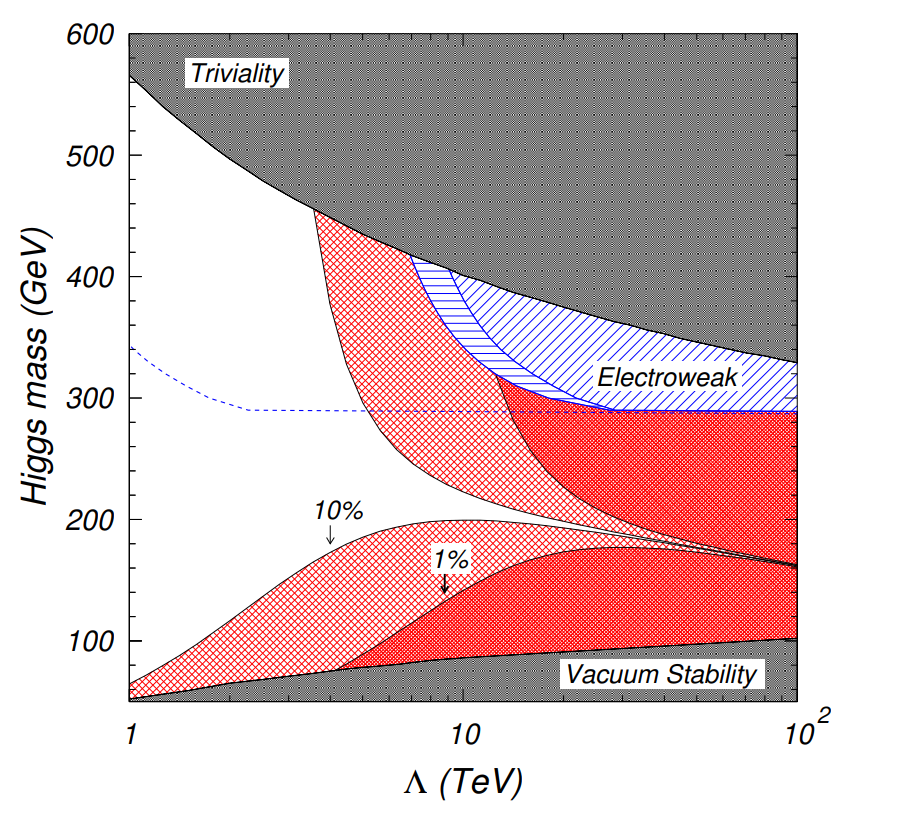
As expected from the spin-statistics argument, the boson and fermion loop contributions have opposite sign. This implies that it is possible that vanishes and the Higgs mass is protected from quantum corrections at one loop. This is known as the Veltman condition.
In general, a degree of fine-tuning can be defined as
.
- is “natural” or fine-tuning is absent.
- Requiring the above is used to set upper bounds on ().
- If the SM needs to hold up to the Planck scale , then SM is fine-tuned at the level of .