1. Galactic scale
Rotation curves of spiral galaxies - On applying Gauss Law to spiral galaxies, we get a simple relation between the rotation speeds of the objects that are gravitationally bound to the galaxy and their distances from the galactic centre:
where M is the mass contained within the radius r. In the outskirts of the galaxy, where we expect that M does not increase any more, we would expect a decay .
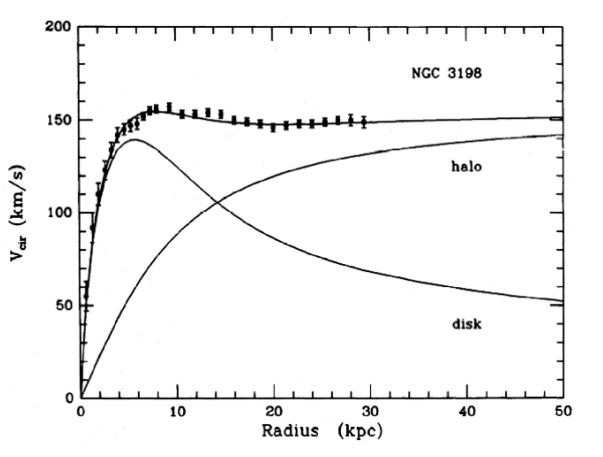
The flatness of the curve can be obtained if a new mass component is introduced, whose distribution satisfies in the previous equation (a self-gravitational gas of non-interacting particles).
This halo of DM can extend up to ten times the size of the galactic disc and accounts for approximately 80% of the galaxy’s total mass.
2. Galaxy Clusters
-
Peculiar motion of clusters - Aim of the study was to measure the total mass of a system through a method that did not rely only on the information from visible objects (included faint and non-luminous components). Results showed an extremely large mass-to-light ratio, indicating the existence of large amounts of missing mass (a DM component?).
-
Dynamical Systems - A paradigmatic example is the Bullet Cluster. It consists of two galaxy clusters that underwent a collision. The visible components of the cluster display a characteristic shock wave. On the other hand, weak-lensing analyses have revealed that most of the mass of the system is displaced from the visible components. The accepted interpretation is that DM components of the clusters have crossed without significant interaction.
-
DM Filaments - Observations of the distribution of luminous matter at large scales show that it follows a filamentary structure. It is well understood that DM plays an important role in creating this filamentary network, gravitationally trapping the luminous matter.
3. Cosmological Scale
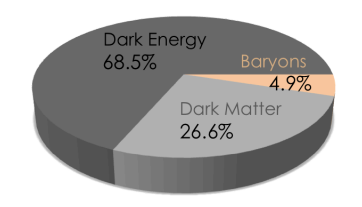
Data obtained by dedicated satellites (to observe CMB) has confirmed that we live in flat universe dominated by dark matter and dark energy, whose cosmological abundances have been determined to the Planck scale.