
In a gist, when Beta decay was discovered, the electron was expected to have a fixed energy due to energy conservation. But a spectrum of energies of the decay product (electron) was observed instead.
So, the existence of a new, electrically neutral particle in beta decay was proposed to explain the anomaly of a continuous spectrum.
It was Fermi who proposed that this particle (dubbed as a “neutrino”) should be light, spin-1/2 and electrically neutral.
It was later showed that the interaction cross-section of a neutrino must be very small ⇒ it can pass through the earth without deviation.
The famous Cowan-Reines experiment (indirectly) proved the existence of an electron neutrino. Gaillard, Lederman, Schwartz and Steinberger built a Spark Chamber to detect muon neutrinos coming from pion decays.
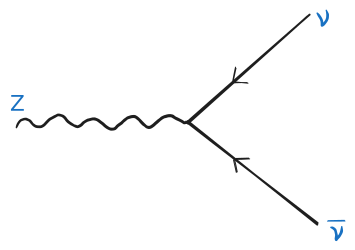
It was found that neutrinos couple to weak gauge bosons and will modify their decay width. The width measurement of Z bosons by the Large Electron Positron collider (LEP) confirmed 3 generations of neutrinos.
The Tau lepton was discovered:
It was confirmed by the DONUT experiment that the products had 4 neutrinos and the OPERA experiment observed about 10 tau neutrinos!