It was proposed that hadrons were made up of quarks and anti-quarks which were spin-1/2 fermions with fractional charges.
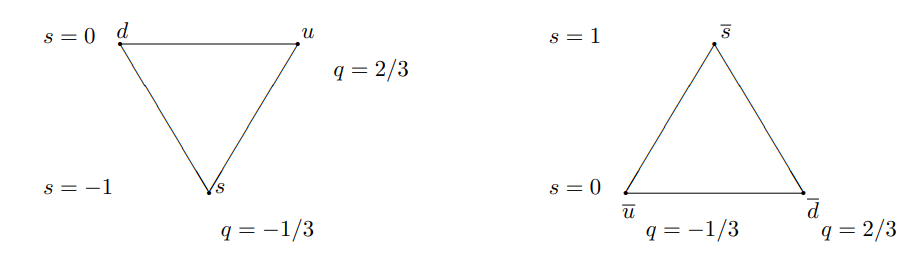
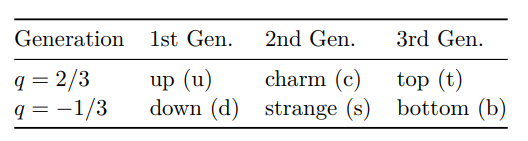
The hadrons could then be classified based on their quark content as:
- Mesons: One quark and one anti-quark
- Baryons: 3 quarks
However, this created a problem. The ∆++ was a spin-3/2 baryon composed of 3 up quarks; multiple fermions in the exact same state, thus violating Pauli’s Exclusion principle.
Solution: Introduce a new quantum number called colour with at least 3 distinct values and the rule that all naturally occurring particles are colourless.
The colour charges are denoted by r (red), g (green) and b (blue). Note that this notation has nothing to do with physical colour (that we see). It is just an accepted convention.