
The Feynman Rules - Covariant Gauges contained both colour and kinematic factors. To organise the calculations, we separate the two components:
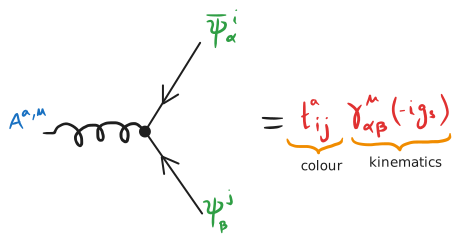
We can apply this colour decomposition to complete amplitudes, abstractly,
where A is an amplitude, the C are colour factors and the A are ordered of partial amplitudes (containing just the kinematic part of the amplitude). For cross sections, we need the squared amplitude, summed over all colours and averaged over the initial state,
where the matrix is a function of or the Casimir invariants.
-
An example: Consider the scattering
There 3 associated Feynman diagrams:
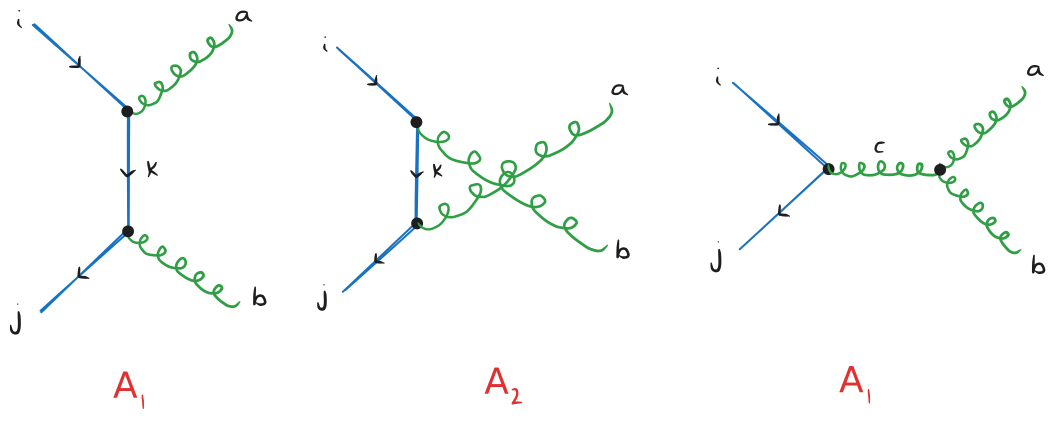
The indices i, j, k indicate the fundamental colour indices of the quarks and a, b, c indicate the adjoint colour indices of the gluons.
The colour factors C are given by:
Hence, the amplitude can rearranged and written as
By defining the colour matrix , we can evaluate the colour interferences pictorially using the graphical rules introduced in Graphical Representation of Colour Group Algebra.
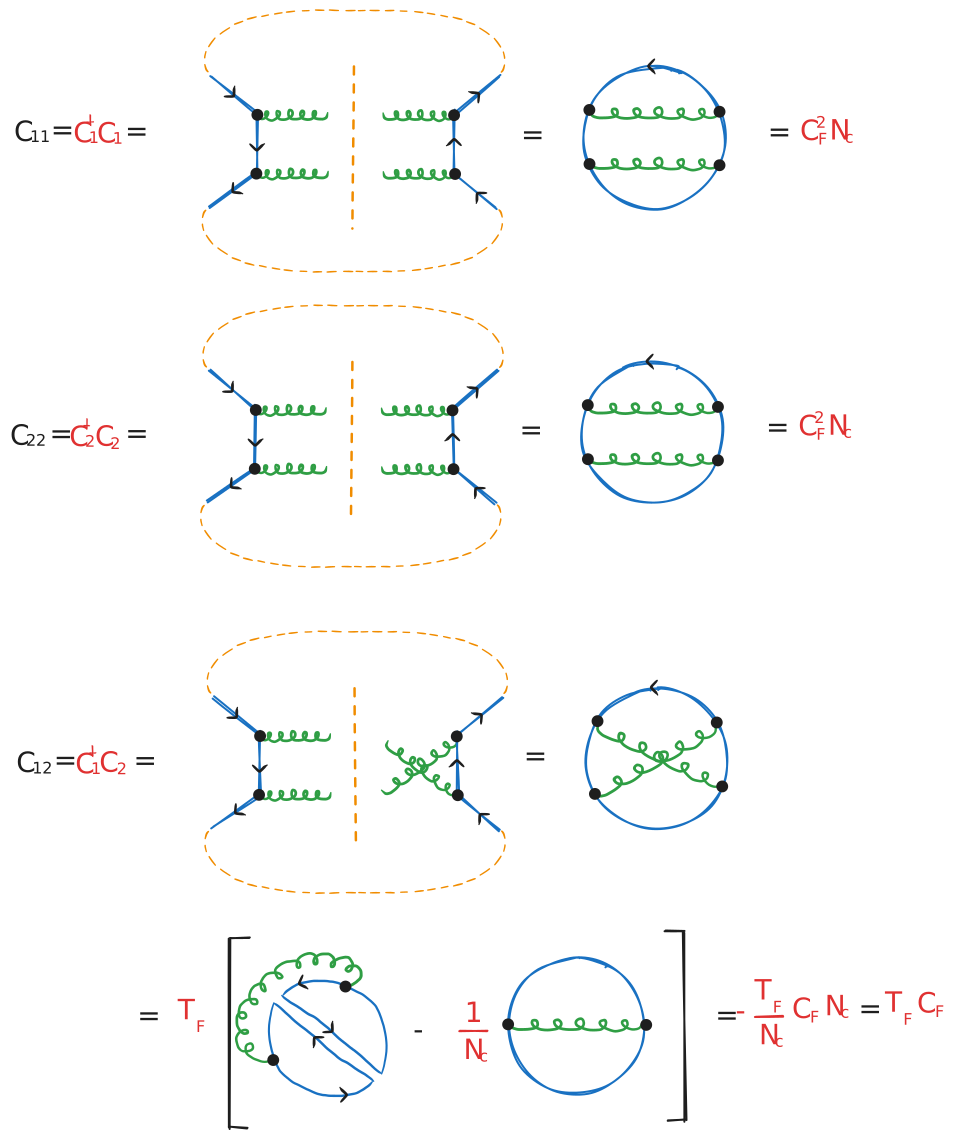
With by symmetry, the full matrix is given by,