
It “claims” the universe to be continually expanding, where everything we see originated from a primordial hot plasma (basically the ‘big bang’).
1parsec = 3.0856 × 10^13 km.
Earth orbits at a distance of 1 microparsec from the Sun, which is 8 kpc away from the centre of the Milky Way Galaxy (50 kpc in diameter).
The nearest neighbouring galaxy, Andromeda, is 770 kpc away and is the largest in our local group (~20 galaxies), placed in the outskirts of the Virgo Supercluster (30 Mpc in size).
That being said, Cosmology involves itself only with distances above Mpc. As crazy as this cosmological scale seems, we humans have managed to scale distances from as tiny as 10^-22 m in the LHC to such humungous astronomical scales!
1.Hubble Diagram
-
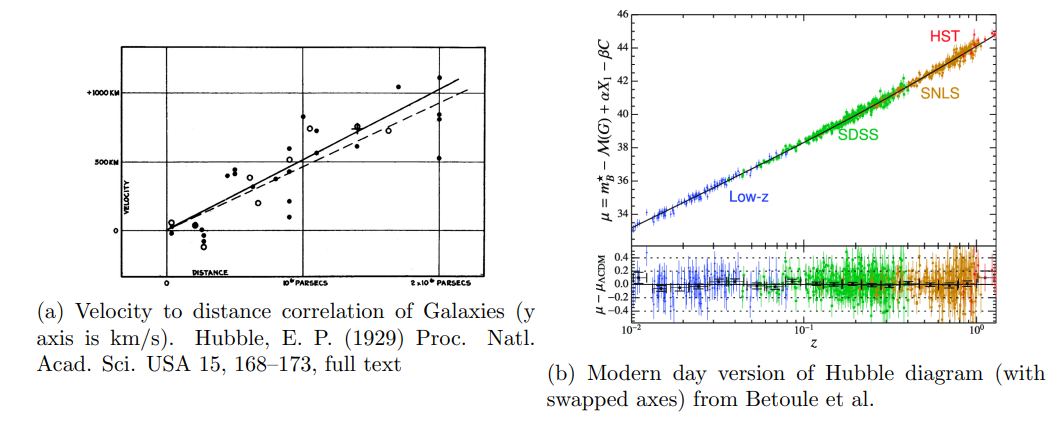
In 1929, Edwin Hubble put out an article with the distances and relative velocities of a few dozen “galaxies”. Though, when Hubble had started his research, these “galaxies” were thought to be nebulae within the Milky Way (talk about pretentious behaviour). Hubble, with a 100 inch telescope in California, identified Cepheid stars, whose luminosity varies periodically with a frequency tightly correlated with absolute luminosity. By measuring their apparent luminosity, Hubble estimated that Andromeda was 300 kpc away! Milky Way had just recently been discovered to be ~ 30 kpc wide. So these “Nebulae” were indeed well outside the Milky Way.
-
To find the relative velocity, one can use the emission spectrum instead of the intensity of light. We set the Hydrogen spectrum as the standard. for eg. the transition between the two hyperfine split 1S states of H has a wavelength of 21 cm. The spectral lines from outside earth do not exactly sit on top of the lines measured on earth; they have a higher frequency (blue shifted) or a lower frequency (red shifted). Reason for this shift → Doppler effect.
The relation between the spectrum displacement and the relative velocity is given by:
z is called the redshift and the last equality holds good in the non-relativistic limit (v<<c).
-
The slope of the linear correction in fig. 3a is called the Hubble rate H₀. This linear correlation tells us that velocity is proportional to distance i.e., galaxies are receding from us and faster the furthest way.
2. Cosmic Microwave BackgroundCMB
Cosmic radiation coming from the early stages of the universe, now redshifted into the microwave region.
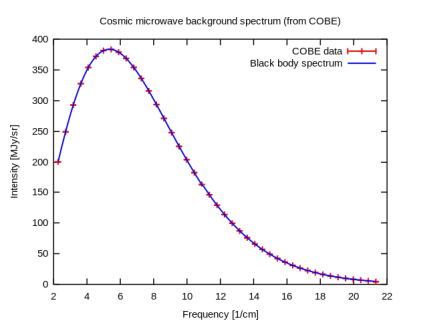
The prediction in the graph is that of black body radiation. Such a (distinctive) curve depends only on temperature T. Hence, the intensity can be written as:
This is hence the most ideal black body radiation we have observed. From the plot, we can extract the associated temperature which is the CMB temperature today.
3. The early Universe
From Hubble’s observation, if at cosmic distances, everything is moving away from us, then at some point in time, they were all closer and we can estimate when
using substitutions from Hubble’s Law.
- The current estimate for the age of the universe is 14 thousand million years. How does the Hubble estimate compare with this?
- Further, when all matter was clumped together at the beginning, the energy per unit volume of the system must have been exceedingly large. In fact, if it was hot enough, electrons would have been stripped from their orbits and for higher temperatures, the nuclei would have dissociated into protons and neutrons.
- The fact that the spectrum so closely follows that of a black body tells us that the early universe was in a nearly perfect equilibrium.
Thus, we now have two basic concepts that thread through most of cosmology:
- The universe is expanding.
- The universe, in its early stages, used to be in thermal equilibrium with temperature T.