
We replace particles by strings. But what are these strings?
Consider the worldline of a particle.
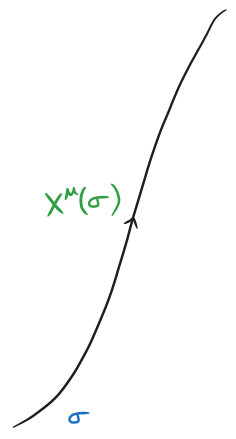
It has a parameter with coordinate .
A string has a 2-d worldplane (2-d version of a worldline).
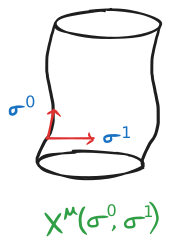
Why do we use strings? With strings, there is a potential for simplification.
-
In the case of particles, we need to specify the particle types and interactions, which require additional data.
-
In the case of strings, quantising the oscillation modes of a single string results in an entire spectrum of excitations that behave as particles at long distances or low energies. The interactions between them are fixed without any other additional information.
There are roughly two types of strings: open and closed. The massless excitations of open strings behave like photons and gluons, while those of closed strings behave like gravitons. There are also a lot of massive excitations.
Hence, string theory naturally gives rise to theories of gauge fields and gravity that are consistent.
However, this consistency requires a spacetime dimension greater than 4. In particular, bosonic string theory requires D=26, while superstring theory require D=10. Hence, we consider spacetimes of the form with a preference for d=4.