
Let us consider a massive relativistic particle moving in flat D-dimensionalMinkowski space-time. The relativistic action principle, in non-relativistic notation is,
.
The canonical momenta are and the energy is .
The change in action is
and thus the equations of motion are .
This formulation is asymmetric between space and time. So, to find a manifestly relativistic action principle, we introduce orthonormal coordinates onMinkowski spacetime .
The world-line of a particle is then specified by coordinate functions depending on some real parameter .
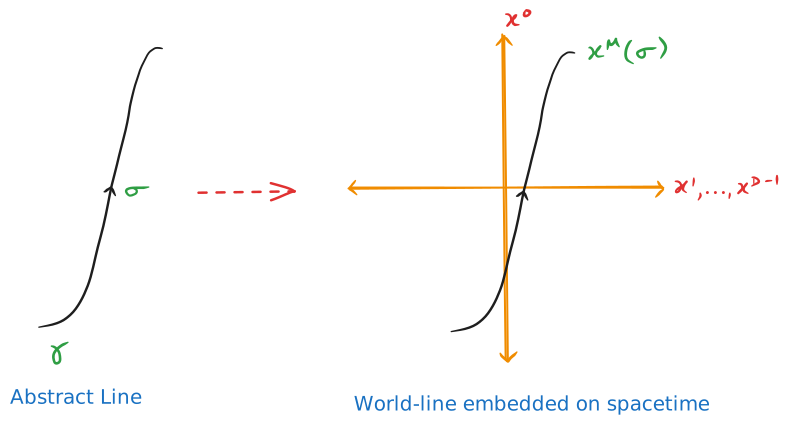
This can be viewed as a map
If the particle is massive, the tangent to the world-line must be timelike:
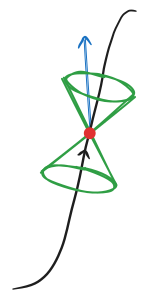
where .
Then, the relativistic action principle is,
which is proportional to the proper time . Therefore, we recover the important result that the world-lines of massive particles extremise proper time. The solutions are thus straight lines in .
This action principle has two important properties:
- Poincaré Symmetry. It is manifestly invariant under Poincaré transformations,
where .
It is a global symmetry that transforms classical solutions.
- Reparametrisation Invariance. It is independent of the choice of parameter. If we introduce a new parameter , we have
under which the action is invariant. Thus, we can choose the parameter , and thereby reproduce the previous action (in non-relativistic notation).
It is a gauge redundancy that changes the parametrisation of classical solutions.