
Any CFT (classical field theory), upon quantisation, gives us the Hamiltonian and Fock Space. We use these to lay out the expectation for any given observable (Hermitian operator).
- Schrödinger
.
- Heisenberg
.
Now, these two pictures are equivalent since the position is a label.
We define the evolution operator and so both pictures give .
For quadratic harmonic-oscillator-like theories, evolution is simple:
.
Then,
.
For higher terms, we use the Baker-Campbell-Housdorff formula
and show that where
which carries over to .
The label will be useful when talking about Interactions.
We can also use the Euler-Lagrange equations for the operator to obtain this solution,
.
Now, .
Setting aside the infinity (resolved by renormalisation), the Hamiltonian expectation value is the energy, its squared will be , etc. But what about the field itself?
,
where we have used and . So the expectation value of a field in a one-particle state is zero, i.e., if we measure the field value at any point at any time, we will get a on average. This however does not mean that the field is not moving since for , the expectation value is non-zero. From this, we can conclude that the field is moving (oscillating) around . We can picture our states as “ripples” on the field, around an average level:
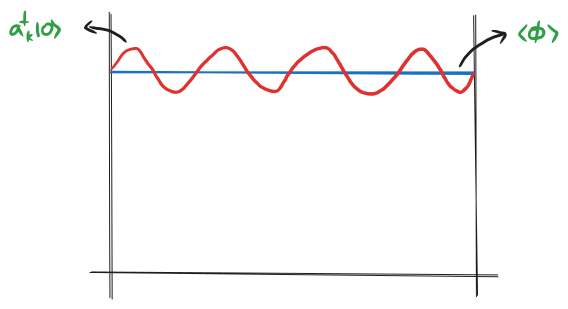
Note: for any . We can build with a superposition of different states. This allows us to qualify the statement “light is made up of photons” to “light is a superposition of multiphoton states”.
Number and Momentum Operators
.
Thus, .
An eigenstate of then has a well-defined number of particles and since , they cannot be simultaneously eigenstates.
This counting can be used to define total momentum as . Then,
and .